
By Anthony Mwangi
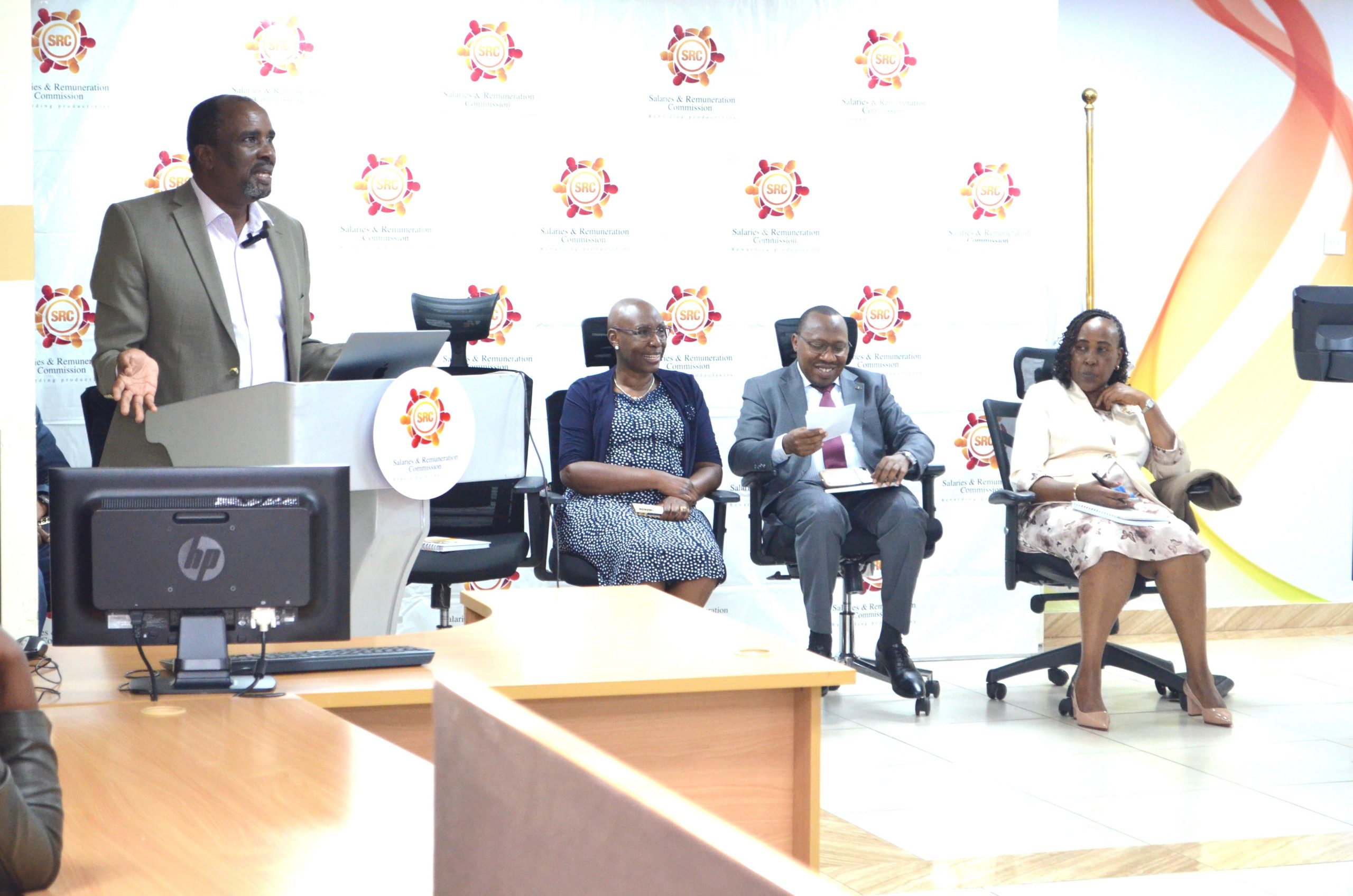
The Commission and Secretariat staff participated in a captivating seminar on the role of Constitutional Commissions and Independent Offices (CCIOs), facilitated by Advocate Dr. Kamotho Waiganjo.
The seminar, which took place at SRC offices on 23 March 2026, deepened staff understanding of SRC’s constitutional mandate beyond its core technical functions.
SRC is established under Article 230 of the Constitution, while Chapter 15 sets out the broader framework for CCIOs. The internal seminar provided a broader constitutional context for SRC’s work within Kenya’s 2010 constitutional order.
It underscored the shared mandate of Chapter 15 institutions to protect the sovereignty of the people, secure observance of democratic values and principles by State organs, and promote constitutionalism.
Further, it reinforced the importance of the Commission internalising its role in advancing the SRC’s constitutional mandate.
Drawing from his experience as one of the architects of the Constitution, Dr. Waiganjo opened the seminar by locating SRC within the historical and political context of Kenya’s constitution-making process.
He observed that the promulgation of the 2010 Constitution was driven, first, by the desire of ordinary Kenyans to be more fully included in political, economic and social life, and second, by the need to curb the excesses of power, particularly in the wake of the 2007/2008 post-election violence.
He noted that devolution, together with the establishment of CCIOs, was a deliberate response to the challenges of exclusion and unchecked authority. The Constitution, he emphasised, was intended to restructure government and place Kenya on a more inclusive, equitable and accountable constitutional path.
He drew participants’ attention to Article 249 of the Constitution, which affirms the independence of CCIOs and requires Parliament to provide adequate funding for their work.
In the case of SRC, protecting the sovereignty of the people means ensuring that remuneration is subject to independent oversight and is not determined by those with a personal interest in the outcome. SRC’s mandate is, therefore, not simply administrative; it is a constitutional guardrail.
SRC was reminded that the security of tenure enjoyed by Commissioners, their financial independence, and the constitutional entrenchment of their mandates exist not as privileges, but as structural protections designed to insulate SRC from political interference and to preserve public confidence in its independence.
A key theme of the seminar was the distinction between SRC’s technical mandate and its broader shared mandate as a Chapter 15 institution.
Dr. Waiganjo noted that while many CCIOs have discharged their technical responsibilities effectively, they have sometimes fallen short of the constitutional test that requires active promotion of constitutionalism, protection of sovereignty, and accountability of State organs.
Commissioners and staff were challenged to reflect on what SRC does and what it represents constitutionally and whether its work advances the transformative vision of the 2010 Constitution.
The seminar also examined the balance between institutional independence and practical interdependence with other State organs.
While the Constitution protects CCIOs from direction or control by any person or authority, effective performance of their mandate still requires constructive engagement with other institutions.
Dr. Waiganjo cautioned that such engagement must never dilute SRC’s mandate or compromise its independence. He noted SRC must navigate pressure from other arms of government with principled firmness to preserve its constitutional role.
The discussion further addressed the need to balance fiscal sustainability with the imperative to attract and retain productive public servants.
The challenge of managing the wage bill against revenue was raised, together with the broader question of how public resources are allocated between salaries, allowances and other emoluments.
The seminar underscored the importance of linking remuneration policy to productivity, efficiency and the responsible use of public funds.