By Jael Keya
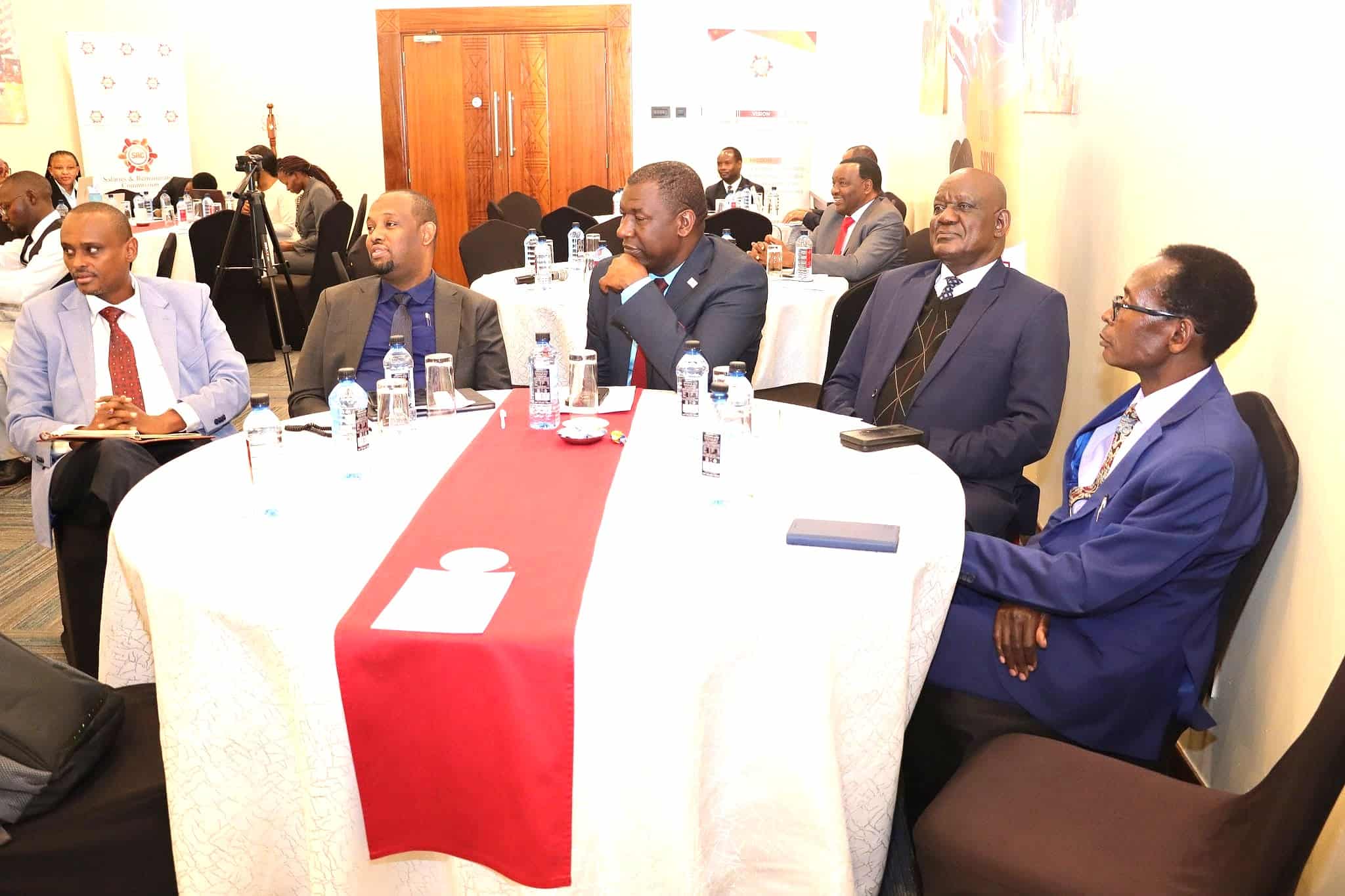
The Commission participated in a two-day induction at the Sarova Panafric Hotel, Nairobi, from 29 to 30 July 2025. The induction saw Commission Members engage several key stakeholders.
The induction aimed at providing an opportunity for the Third Commission to better understand stakeholders, and thereby, build lasting partnerships to facilitate the effective implementation of SRC’s mandate.
Day 1 Induction
Dr. Ludeki Chweya, former Director General of the Kenya School of Government (KSG), provided a conceptual framework on the quality of public service delivery anchored in the constitutional values and the historical evolution of public administration. He emphasised the importance of aligning service delivery with constitutional principles.
Prof. Chweya drew distinctions between the State and government, while insisting on the need for Article 10, 232 and 47 of the Constitution to shape and guide the conduct of the Commission. He noted that it is crucial for SRC to uphold national values in every decision and action, while demonstrating high levels of professionalism in all its engagements.
On his part, Eutycus Githinji from the Government Reception Office, Ministry of Interior and National Administration, affirmed that true power lies in the grace of one’s conduct, adding that where manners rise above laws, protocol upholds respect and dignity.
His presentation focused on the principles, structures and practices that guide official conduct of individuals particularly in high-level State functions. Githinji differentiated State protocol and diplomatic protocol.
He outlined key reference documents that guide protocol operations, including the ministry organogram, scheme of service, order of precedence bill, executive orders, and the revised manual on State protocol.
In his presentation, Gershom Otachi, Chairperson of the National Land Commission and who also doubles up as the Chairperson of the Forum for Constitutional Commissions and Independent Offices (CCIOs), reflected on the journey, challenges and progress of CCIOs since their formation in accordance with the Constitution.
Otachi elaborated on the emphasis placed on the independence of each Commission, while acknowledging their interdependence in executing public functions.
He elaborated on milestones of the Forum for CCIOs, including institutionalising transparency and accountability, adding that CCIOs form a vital framework of checks and balances in Kenya’s governance system.
Patrick Nyangweso, CEO of the National Taxpayers Association (NTA), affirmed NTA’s cordial working relationship with SRC, nurtured over the last few years. He noted that the relationship ensured continued support towards the management of the public wage bill and accountability to taxpayers.
He reminded SRC that part of its core mandate is to leave a legacy through meaningful reform and responsible service to the public.
While calling attention to the current public wage bill, which is a key concern of SRC, Nyangweso welcomed SRC’s commitment to resolving the issues by June 2028, as adopted during the National Wage Bill Conference held in 2024.
To close the first day, Dr. Nancy Booker, Dean at Aga Khan University, spoke about the media landscape in Kenya, while guiding the Commission on how to navigate media interviews.
In her presentation, Dr. Booker said public officials must understand the media landscape and actively manage media engagement. She shared practical tips on preparing for and handling media interviews. She noted the impact of the media on public relations, storytelling and crisis communication.
At the conclusion of first day, Sammy Chepkwony, SRC Chairperson, reiterated SRC’s deliberate strategic engagement with stakeholders. He said the induction by stakeholders brought out areas of synergy that SRC needed to explore further.